Meaningful Human Control: Keeping Humans in the Loop
- Editorial Team

- May 29
- 6 min read
New here? Subscribe to our blog to receive our latest insights directly in your inbox.

Part 2 of the Touchwaves Kill Chain series.
In our previous blog post, we established that the pilot remains the weapon system. As autonomy advances and the operator moves out of the cockpit, the central challenge becomes meaningful human control — and that challenge, we argue, is ultimately a question of situational awareness rather than authority.
Take a look at our previous Blog Post before continuing this reading!
In our previous analysis, we traced the contribution of touch across all six stages of the F2T2EA kill chain and closed on a deliberate, unresolved question: as artificial intelligence assumes more of Find, Fix and Track, how does the human supervisor retain meaningful — not merely formal — control?
This article addresses that question directly.
The operational trajectory is clear. Unmanned aircraft systems (UAS) and autonomous platforms are taking over more stages of the kill chain, and the human operator is moving from the cockpit to the ground control station — from inside the aircraft to in front of a console. The way used to describe what remains of human control is human-in-the-loop, and it now appears throughout defence doctrine, procurement requirements, and the international debate on autonomous weapons systems.
But "human-in-the-loop" only informs that a person is positioned to make the decision. It does not, in itself, describe a capability. The difference between the two is where meaningful human control quietly breaks down.
Meaningful human control is not about authority. It is about awareness. An operator can hold formal decision-making authority and still be unable to exercise it well, if the conditions of remote operation have eroded the situational awareness that judgement depends on.
What does meaningful human control actually require?
Three configurations of human involvement are conventionally distinguished.

Human-in-the-loop
The system cannot act without operator input.
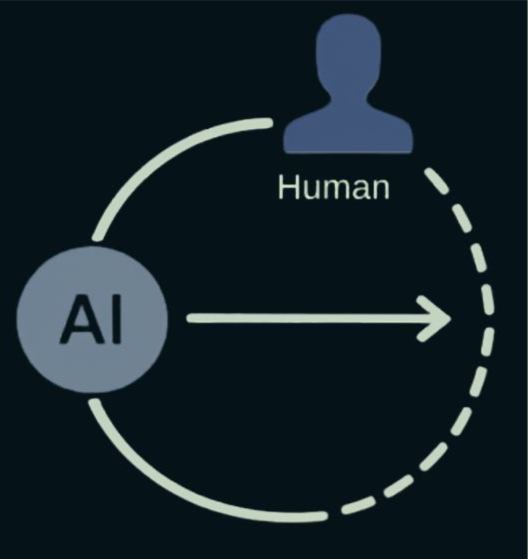
Human-on-the-loop
The system acts autonomously while the operator supervises and retains the ability to intervene.

Human-out-of-the-loop
The system selects and engages targets without human involvement.
Sitting above these is the idea now at the centre of legal and ethical debates: meaningful human control.
The core principle is that humans — not machines — must make the context-specific judgements that international humanitarian law requires. The core rules of war — distinction, proportionality and precaution — cannot be reduced to a calculation.
Each one needs a person who understands the situation well enough to weigh likely civilian harm against military gain, and to suspend an engagement when that picture changes.
This is the part most discussions overlook.
Meaningful human control is usually treated as a question of authority — who is allowed to decide.
But it is, first and necessarily, a question of awareness — whether the human with that authority can perceive enough to decide responsibly.
Judgement cannot be exercised over a situation that the operator has lost track of.
Why a human-in-the-loop is not a human in control
The human factors literature resolved this question decades ago, and automation has only sharpened its relevance.
In 1995, Mica Endsley and Esin Kiris identified the out-of-the-loop performance problem: when automation assumes a task, the operator supervising it shifts from active to passive information processing.
Situational awareness degrades as a consequence — and, critically, the operator becomes slower and less reliable at resuming manual control at the precise moment the automation reaches its limit or fails. The human remains marginally present. They are simply no longer holding an accurate overview of the unfolding situation.Interested in learning more about this topic? Read about how 3 different aircrafts (F-35, Apache, and F-16) lead the pilot to the same cognitive overload point.
This is the structural trap of supervisory control.
The more capable the automation, the less the operator does; the less the operator does, the more their situational awareness decays through vigilance decrement and automation bias; and the moment that demands human judgement — the ambiguous contact, the time-sensitive target, the determination that carries legal weight — arrives to find an operator reduced to a passive monitor.
An operator kept in the loop on paper, but out of the loop in awareness, satisfies the procurement requirement while failing both the operational and the legal one.
Meaningful human control doesn't fail because the human lost authority. It fails because no one protected the awareness that authority depends on.
Why distance degrades situational awareness
There is a second, less examined reason the remote operator is uniquely exposed — and it is the reason haptic feedback matters here even more than in the manned cockpit.
As mentioned in our previous Blog Post, the fighter pilot's constraint was saturation: two sensory channels, vision and audition, overloaded with displays, symbology and auditory warnings. That pilot, however, retained a body within the aircraft — vestibular cues, the pressure of g-loading, peripheral and ambient awareness of attitude and motion. This embodied layer of situational awareness operates beneath conscious attention and is never explicitly processed.
Remove the operator from the platform and that entire layer is removed with them.
The UAS operator has no vestibular input, no proprioceptive feedback, and no peripheral sense of the aircraft in space.
Everything they know about the platform arrives through a display and a headset — through the two channels that were already the most congested.
Distance does not simply introduce latency; it strips away the physical dimension of awareness that a pilot never has to think about because they feel it automatically and directly.
The remote operator therefore confronts both failure modes simultaneously: the saturated visual and auditory channels discussed previously, and the sensory deprivation of having no body in the loop. This is exactly the condition under which awareness decays into passive monitoring — and exactly the condition meaningful human control cannot survive.
So if the goal is to keep the human meaningfully in control, there's one concrete question we can't avoid:
How do we give the operator back the awareness that distance took away? Vision and hearing are already at capacity. One channel remains.
How haptic feedback keeps the human in the loop
The tactile channel is uniquely suited to this role, for reasons that map directly onto each failure mode identified above.
Haptic feedback keeps the operator perceptually active.
The out-of-the-loop performance problem is driven by the shift from active to passive processing. A continuous tactile channel — conveying orientation, system state and threat direction to the body — keeps the operator perceptually coupled to the platform rather than passively observing it, sustaining the situational awareness that supervisory control otherwise erodes.
Haptic feedback restores embodied, spatial awareness.
Touch is naturally suited to carrying orientation and spatial information — it is part of how the body keeps track of where it is in the first place. A tactile channel can deliver orientation, system state and threat direction straight to the body: a continuous, felt reference of the kind a screen cannot provide. For an operator who has been removed from the aircraft, this gives back a version of the embodied awareness that distance took away — not another display to interpret, but something they can simply feel.
Haptic feedback recaptures attention without competing for saturated channels.
A warning rendered on a display, within an already saturated visual field, carries a high probability of being missed. A tactile cue opens a parallel channel; it reaches the operator at the decisive moment without adding to a visual and auditory load that is already at its ceiling.
Haptic feedback preserves the cognitive bandwidth that judgement requires.
This is the throughline from Part 1: the benefit of haptics increases with cognitive load. By offloading orientation and system-state monitoring onto the tactile channel, haptic feedback frees the operator's finite cognitive resources for the judgements that cannot be delegated.
Discover more about the advantages of tactile communication in our previous Blog Post
The argument reduces to a single proposition: haptic feedback is how an operator who is no longer in the cockpit is kept meaningfully in the loop.
Conclusion: control you can feel
Meaningful human control will not be secured by decision architectures, by maintaining a nominal human presence, or by inscribing "human-in-the-loop" into a requirements document. Such measures preserve the position of control while leaving the capacity for it unguarded.
Control is genuine only when the operator can perceive enough to judge, and judge in time to act. As autonomy advances and the human moves progressively further from the platform, protecting that perceptual capacity becomes the decisive question — and it cannot be protected through two sensory channels that are already saturated.
Touchwaves exists to open the third. Not to keep a human in the loop on paper, but to keep them in it where it matters: in awareness, in judgement, in control.
Autonomy is advancing rapidly. Meaningful human control must keep pace — and it will do so only if the operator can feel it.


Comments