Drone Operator Cognitive Overload: The Human Factor Behind 2026's Production Scale-Up

Ukraine will build over 5 million drones in 2026. We look at why operator fatigue and cognitive overload, not the production, is becoming the real bottleneck, and why regulation still overlooks the human piloting the drone.

New here? Subscribe to our blog to receive our latest insights directly in your inbox.
In July 2026, NATO's deputy military commander, Air Chief Marshal Johnny Stringer mentioned that Ukraine's drone production this year would be "well north of 5 million" units. Back in 2022, it was 5,000 units in comparison, that’s a thousandfold jump in four years. Take a second with that. Every single one of those drones needs a person behind it to fly it, track it, or try to shoot it down.
Capital scales in quarters. Cognition doesn't scale at all.
That's the gap this piece is about. Production gets all the headlines because it's the easy number to point to. The operator doesn't make headlines the same way, but they are the ones whose training takes months, whose attention has a hard ceiling, and whose eyes and ears were already maxed out before any of this scale-up started.

To what extent can you scale up a pilot?
We came across a piece of Ukrainian drone-industry analysis from earlier this year that put it really plainly: the more drones you launch, the worse the average operator performs. Not because they're less skilled or less motivated but simply because there's a limit that training simply cannot train away. Pilots have become one of the scarcest things in this whole system. Each one takes months to train, is hard to replace, and can't be duplicated on the same timeline as a drone.
Here are a few insights that help explain what's actually going on with pilots as this scale-up plays out:
Training does not compress the way manufacturing does.
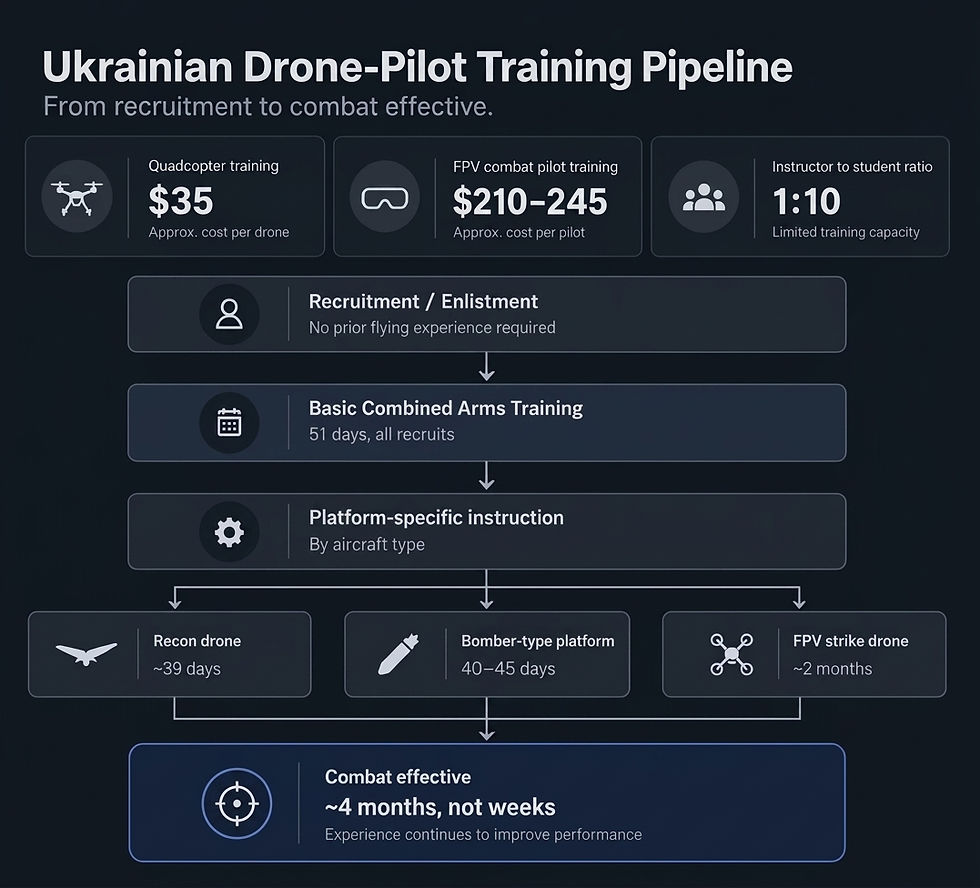
A production line can double its output within weeks. A pilot cannot be developed on the same timeline, and the process itself is more involved than it might appear. In Ukraine, recruitment does not require prior flying experience — most candidates enter the Armed Forces' drone units from zero and complete a standard 51-day Basic Combined Arms Training course before beginning platform-specific instruction, at a typical instructor-to-student ratio of around one to ten. That specialized instruction varies by aircraft type: roughly 39 days for a basic reconnaissance drone, 40–45 days for a bomber-type platform, and closer to two months for FPV strike drones, according to interviews with pilots, unit commanders, and training staff conducted by Kyiv Post.
Ukraine's own drone command has separately stated that four months, not weeks, is what it actually takes for a pilot to become effective, with no real ceiling on how much further experience continues to improve performance. On the cost side, per-pilot training itself is remarkably inexpensive relative to the hardware it produces: one Ukrainian training-school director told Defense One that training a soldier on a basic quadcopter costs around $35, while training an FPV combat pilot costs six to seven times that — roughly $210–245 per pilot, covering instructor time, simulator hours, and expendable practice drones.
That figure has likely risen since as fiber-optic and EW-resistant platforms have entered service, but it illustrates the underlying economics: the constraint on drone-pilot output was never really the price of training a person. It has always been the time it takes, and the finite number of instructors and simulators available to run that training at scale. Additional funding accelerates production. It does not accelerate the pipeline that produces a trained pilot, which is precisely why pressure continues to build on the operators already in service.
n
Fatigue doesn't care how good you are.
Even the best-trained operators show measurable neurocognitive decline under sustained load, and it tends to surface at exactly the wrong moment such as mid-jamming, under fire, in the last few seconds that matter most. A recent fNIRS study on novice UAV pilots, published in the International Journal of Human-Computer Interaction in late 2025, put numbers behind this: when 26 operators flew a dual-task profile while holding overhead alignment and running a concurrent auditory working-memory task, researchers recorded a measurable rise in perceived workload alongside increased activation in the prefrontal cortex, concentrated in the inferior prefrontal region associated with auditory attention. Flight accuracy held up, but only because pilots unconsciously adopted compensatory strategies: slowing their approach speed and reducing control input to protect performance.
More drones in the sky means more cognitive overload.
A meta-analysis of 27 UAV swarm-management studies published in Applied Ergonomics found that swarm control consistently produces high cognitive demand, non-intuitive system behavior, and outsized consequences for operator error. Crucially, the interventions that actually improved situational awareness were not the ones that gave the operator a richer picture, they were the ones that raised the swarm's level of autonomy specifically to reduce operator cognitive workload, and allowed user and mission-specific customization of the interface itself. In other words the fix that worked wasn't more data on the screen. It was less for the human to have to process in the first place.
So here's the pattern: drone output and human capacity are on two totally different curves. The faster one climbs, the wider the gap to the other one gets.
The regulations cover the drone but not so much the person flying it
This wouldn't be as concerning if the industry were actively engineering around it. It isn't, at least not yet, and that gap is what stands out most.
Regulators have spent the better part of a decade building out detailed rules for the aircraft, airspace, remote ID, flying beyond line of sight, certifications, and more. The human piloting that aircraft? Barely a mention, until very recently. A DRONELIFE deep-dive from mid-2026 put it bluntly: regulation around the human side of drone operations is still "nascent," even as missions get longer and more demanding by the month and the safety numbers keep telling the same story, no matter where you look.
A companion DRONELIFE piece points to research showing human factors are one of the biggest drivers of drone incidents once the mental workload crosses a threshold, response times slow, awareness drops, decisions get worse, mistakes go up. It doesn't matter whether we are talking about a €400 FPV or a multi-million-euro fixed-wing platform. The pattern holds is the same and the cognitive workload it constantly present in the reports.
What we keep seeing in our field
This is the pattern we keep encountering in our own work with partner programmes, and it shows up the same way across every role we've studied: whatever the setting, the operator's visual and auditory channels are already full before a new threat signal ever arrives. What changes from role to role is only the situation that fills those channels up.
For FPV and ground operators, the reaction window is measured in single-digit seconds, and both primary sensory channels are already committed before a threat alert can even register: vision is locked onto a screen or weapon sight, hearing is saturated by gunfire and radio traffic. There's no idle channel left for a new signal to travel through and the alert simply has nowhere to land.
UAS control-station operators run into a structurally identical problem in a different environment. Flying by sight and sound alone, without the proprioceptive feedback a physical cockpit provides, they're tracking flight path, sensor feed, datalink health and radio traffic simultaneously, on the same two senses. That load carries a measurable cost: in controlled studies, close to 40% of pilots missed a critical audible alarm during high-demand flight segments not because the alarm was too quiet, but because auditory bandwidth was already exhausted.
The pattern repeats across every role we've looked at which raises the question: is this actually specific to drones, or is it just the latest version of a problem the aviation world has been fighting for decades?
Read more about this in our previous Blog Post!
Touch: the channel nobody's fighting over
Human attention isn't one shared pool and it is split across separate channels tied to different senses, an idea we go into in more depth in A Multiple Resource Approach to Pilot Safety.
Visual and audio are the two channels every alert system in the roles above is already fighting over. Touch is the one almost nobody uses, a wide-open lane that doesn't compete with a screen, a radio, or a weapon sight, and the sixth sense we think the industry is missing.
That is the space we work in at Touchwaves. We turn threat direction, proximity and priority into graduated vibration, felt directly on the body — landing on a channel the operator actually still has room on, no matter how packed everything else is. In our work with military aviation partners, this kind of tactile cueing has improved flight accuracy by around 40%, cut missed warnings by more than 60%, and gotten critical alerts to operators up to 45 milliseconds faster than a visual cue (more on the numbers in The Science of Haptics) and in the kind of split-second windows we've been talking about, that's not a small thing.
Scaling drone production a thousandfold is genuinely impressive. But scaling the human who has to fly, track, or defend against it all is a completely different challenge and right now, and is the one nobody is really keen to solve.
If you're working on this from the operator side too, we'd love to hear about it. Feels like a conversation the industry needs to be having a lot more out in the open.
About Touchwaves
Touchwaves is a Dutch deep-tech company and TNO spin-off based in Eindhoven, developing wearable haptic technology for aerospace and defence.
Its systems deliver information through touch — bypassing saturated visual and auditory channels — to support situational awareness and cognitive overload management in high-workload environments.
In January 2026, Touchwaves raised €1.5M in pre-seed funding led by SecFund (Dutch MoD), with participation from TNO Ventures, imec.istart, Joanna Invest and the Dutch Research Council (NWO). The company works closely with the Dutch Ministry of Defence, the Royal Netherlands Air and Space Force, and the Centre for Man in Aviation.


Comments