What Makes a Military Pilot Succeed?
New here? Subscribe to our blog to receive our latest insights directly in your inbox.
A 2026 study from the Royal Netherlands Air and Space Force mapped the seven attributes that define a successful military student pilot, and judged which can be developed and which a candidate either has or doesn't. This article presents each one, what the evidence says about training it, and where wearable haptics fit into the picture.
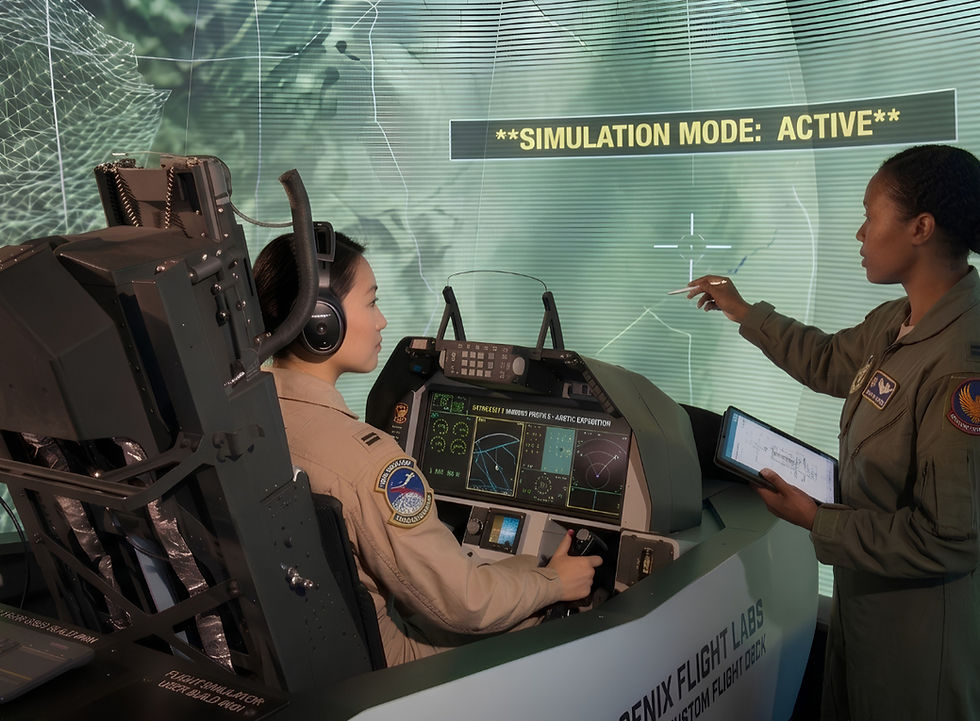
Europe's air forces are being asked to do three things that pull against each other: grow the force, recruit from a shrinking applicant pool, and raise the bar, all while the modern cockpit demands more of the human inside it than any aircraft in history.
Solving that starts with a precise question: what actually makes a successful military pilot, and how much of it can be built?
A new study in Aviation Psychology and Applied Human Factors set out to answer it with focus groups of experienced military pilots, aviation psychologists, and student pilots at the Royal Netherlands Air and Space Force (RNLASF).
The experts converged on seven attribute categories — adaptiveness, cognition, cooperation, effort, forward leaning, mental toughness, and trainability — and on a verdict for each: largely innate, or trainable.
The innate vs. trainable differentiation explains where performance gains are actually available.
Where a trait is innate, selection can screen for it but never build it. Where it's trainable, the right programme can develop it.
The third, historically under-used level in aviation, is reducing the cognitive load on the operator rather than demanding more from them. That is the lever wearable tactile communication offers, and it shows up, to different degrees, across all seven attributes.
# | Attribute | Innate or trainable | Where haptics help | Haptic fit |
1 | Adaptiveness | Trainable | Protects the spare capacity flexibility needs | ●●○ |
2 | Cognition | Innate | Opens a third sensory channel, cutting mental load | ●●● |
3 | Cooperation | Trainable | Silent coordination cues that free the radio | ●○○ |
4 | Effort | Innate | Sustains vigilance through long-mission fatigue | ●●○ |
5 | Forward leaning | Innate | Faster threat orientation for quicker decisions | ●●● |
6 | Mental toughness | Innate | Cuts the stressor; paced-breathing cues aid coping | ●●● |
7 | Trainability | Innate | Immediate, embodied corrective feedback | ●●○ |
Adaptiveness
The ability to adjust to changing circumstances, switching plans when the weather closes in or the mission shifts, moving fluidly between the big picture and fine detail, and finding solutions that aren't in the manual. The experts framed it largely as cognitive flexibility.
Innate or trainable?
Trainable.
Adaptiveness was one of the two categories the study judged most developable through good training.
The research literature backs this up: cognitive-adaptation training has been shown to improve flight performance, and cognitive flexibility partly buffers the effect of stress on decision-making.
Where haptics help.
Cognitive flexibility runs on spare mental capacity — humans adapt when they are not already saturated.
Under heavy workload, the flexible, generalist thinking that adaptiveness depends on is the first to collapse into tunnel vision.
By offloading spatial and threat information to the tactile channel, haptics protect the cognitive bandwidth adaptiveness needs.
Touchwaves' adaptive, closed-loop cueing takes this further: it reads the operator's workload state and adjusts the intensity of feedback accordingly — a subtle pulse in low-workload phases, a sharper signal as demands climb — so the system adapts to the operator instead of adding to the load.
Cognition
General intelligence, information processing, and psychomotor skill — perceiving, prioritising, and acting on a pool of sensor feeds, datalink, threat warnings, and AI-assisted prompts while flying the aircraft. The study found this attribute has grown most in importance over the past decade, increasing the need of pilots "[...] to be somewhat of a data analyst."
Innate or trainable?
Largely innate.
Cognitive ability is the most-researched predictor of pilot success, and the experts treated raw capacity, and psychomotor skill, as closer to fixed than coachable. Crucially, though, the study suggests information processing can improve, but not by growing capacity. Instead, operators get better by becoming familiar enough with tasks that they lean less on working memory. In other words, the gain comes from lowering the demand on working memory, not from expanding cognitive capacity.
Where haptics help.
Haptics help in the most direct way.
Multiple Resource Theory holds that performance degrades when tasks compete for the same sensory channel. Vision and hearing are already saturated in the modern cockpit, producing attentional tunnelling, inattentional deafness, and spatial disorientation — and different aircraft drive that overload through different mechanisms.
Touchwaves opens an independent third channel, translating spatial and physiological data into intuitive vibration felt on the body. That offloads information from the overloaded channels and reduces reliance on working memory, exactly the load-reduction mechanism the study identifies as the real route to better information processing.
You can't train a bigger brain. You can stop overloading the one you have.
Cooperation
Social skills, team orientation, and the ability to work inside a hierarchy: trusting others, focusing on collective rather than individual results, and operating as one crew across the chain. In an air defence engagement, that means sensor operators, weapons controllers, and command nodes acting on a single shared picture, where the outcome turns on the team rather than any one individual.
Innate or trainable?
Trainable.
Cooperation was the second category the study judged highly developable, consistent with decades of crew-resource-management research.
Where haptics help.
A vibrotactile system does not teach social skills. Its contribution is twofold and modest.
First, an operator who isn't drowning in their own sensory load has spare capacity to attend to the team, as cooperation suffers when individuals are overwhelmed.
Second, tactile signalling can carry low-bandwidth coordination cues silently, without competing for the radio and verbal channels a crew relies on, useful in comms-degraded or noise-saturated environments. The benefit is real, but supporting rather than central.
Effort
The internal drivers: motivation, perseverance, ownership, the eagerness to be the best, and the drive to understand every detail. As one student pilot put it, much of training comes down to discipline: choosing to push through when motivation dips.
Innate or trainable?
Largely innate.
Achievement motivation has been rated by fighter pilots as the single most important non-cognitive trait, and the study treated effort as closer to a dispositional characteristic than a trainable skill, though it noted some specific techniques can nudge motivation, and that ownership is partly developable.
Where haptics help.
No wearable manufactures drive. But effort is not the same as the output of effort, and the two diverge under fatigue.
Over a long mission, vigilance decays and a motivated operator still misses cues their tired attention can no longer hold.
By sustaining awareness through a channel that doesn't fatigue the way sustained visual cues do, haptics help operators maintain the performance that effort alone can't carry through hour after hour.
The contribution is to protect the expression of effort, not to create it.
Forward Leaning
A proactive, decisive disposition: assertiveness, the willingness to act under risk, and the ability to make and communicate a decision in a split second. The study links it to the psychological construct of hardiness.
Innate or trainable?
Largely innate.
Forward leaning reads as dispositional, closer to a stable personality characteristic than a trained skill, though it can be exercised and reinforced.
Where haptics help.
Decisive action depends on fast, confident situational understanding; hesitation comes from an ambiguous or disorienting picture.
Tactile cues address this directly. A localised vibration triggers an instinctive orienting reflex toward a threat vector, pre-conscious and faster than a screen icon that has to be located and interpreted.
The body's spatial sensitivity lets the system convey 360-degree threat orientation, and graduated cues let an operator feel distance and closing velocity.
In safety-critical testing, location-based tactile alerts have cut hazard-detection time by an average of 2.5 seconds versus more complex alternatives.
By shortening the path from perception to comprehension, haptics give forward-leaning operators the clear, fast read that confident action is built on, across every stage of the kill chain, from detection to engagement.
Mental Toughness
Functioning effectively under stress and recovering from setbacks: stress tolerance, resilience, and coping. One student pilot described the reality of training as "[...] continuously working at stress peak."
Innate or trainable?
A stable, largely innate requirement.
Resilience is one of the most consistently used constructs in pilot and military selection. The study also points to a trainable component, recommending validated approaches such as stress-exposure training.
Where haptics help.
Stress tolerance is partly a function of the stressor itself, and a major stressor in the modern cockpit is sensory overload.
Reduce the load and you reduce the strain on the operator's tolerance directly.
Touchwaves' work began here: with tactile cueing to guide deep, paced breathing and support oxygen uptake, an active physiological coping mechanism delivered through touch.
Combined with closed-loop monitoring that can detect a rising stress state and adapt the cueing, haptics work on mental toughness from two sides: lowering the demand, and supporting the operator's own regulation under it.
Trainability
Everything needed to absorb knowledge and skill within a limited time: a steep learning curve, the ability to apply feedback, introspection, and a development-focused mindset. As one instructor put it, without the learning curve, a student simply won't make it.
Innate or trainable?
Largely innate.
The experts treated a person's underlying capacity to learn fast as a fixed property, even as it governs how much else they can be taught.
Where haptics help.
Haptics don't change how innately trainable someone is.
What they can change is how efficiently the training environment delivers feedback.
Real-time tactile cues can make corrective feedback immediate and embodied, a signal felt the moment a parameter drifts, rather than verbal and after the fact, supporting the "application of feedback" the study highlights.
The nuance lies in how quickly operators can learn a new tactile language, and how it integrates with existing skills — still an open research question.
The pattern across all seven
The attributes the study judged most decisive, cognition, effort, forward leaning, mental toughness, trainability, are also the ones it judged most innate. Selection can choose for them but can't manufacture them. The trainable categories, adaptiveness and cooperation, can be developed, but they too degrade under overload.
That converges on a single conclusion.
If the most important traits are largely fixed, and even the trainable ones degrade when the operator is saturated, then the highest-leverage intervention is not the human at all.
It is the interface between the human and the machine, the system that decides how much load the operator has to carry in the first place.
It is also how meaningful human control is protected as autonomy takes on more of the workload: human authority over a decision is only as real as the operator's perception of the situation they're deciding on.
This is the same human-performance bottleneck that defines fog and friction in air defence — uncertainty about what's in the sky, and the delay in acting on it. As sensors multiply, the limiting factor is rarely the technology. It is the operator's capacity to absorb it all.
The RNLASF study makes the case from the selection side. Touchwaves makes it from the systems side.
Both arrive at the same place: the bottleneck in modern operations is cognitive, and the way through is to build around the human rather than demand more from them.


Comments